

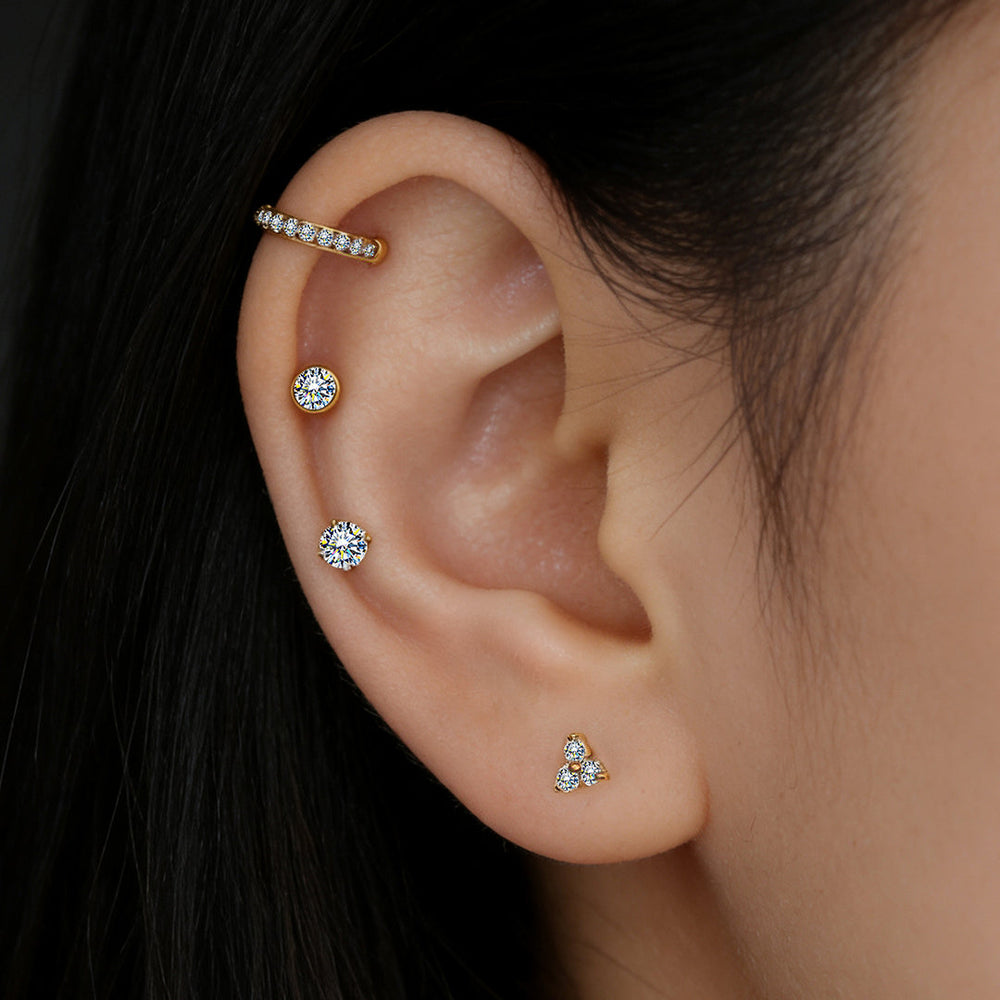
Four measurements buyers should not confuse
The nominal thickness of a post or ring. A lower gauge number generally indicates a thicker piece in the Brown & Sharpe convention commonly used in U.S. body jewelry.
The usable section of a straight or curved post that sits through the piercing, excluding decorative ends.
The open distance measured across the inside of a ring; it is not the outside diameter.
The visible decorative dimensions, including width, height, stone size, and setting profile.
Gauge conversion reference
| Gauge | Nominal millimeters | Use in a purchase specification |
|---|---|---|
| 20G | 0.8 mm | State both units and confirm the actual product specification. |
| 18G | 1.0 mm | Do not assume end or post compatibility from gauge alone. |
| 16G | 1.2 mm | Include connection type and wearable dimensions. |
| 14G | 1.6 mm | Confirm structure, intended placement, and supplier tolerance. |
| 12G | 2.0 mm | Use the supplier’s technical drawing for final acceptance. |
| 10G | 2.5 mm | Nominal conversion; actual acceptance needs the agreed specification. |
| 8G | 3.2 mm | Do not substitute a rounded chart value without confirmation. |
Gauge charts are conventions and can contain rounding differences. A product drawing, calibrated measurement method, and agreed tolerance control the actual order.
Why there is no universal “best size”
The Association of Professional Piercers states that appropriate length or diameter depends on unique anatomy and placement. Jewelry that is too small or too large can create different problems, so “larger is always better” is not a responsible rule.
- Anatomy varies from person to person and from one side of the body to the other.
- The angle and exact placement affect usable length or diameter.
- Initial jewelry and jewelry for a healed piercing may have different fit considerations.
- Rings, straight posts, curved posts, clickers, and specialty structures use different measurements.
- Decorative size and setting profile can affect clearance even when the post measurement is unchanged.
This guide supports product specification and ordering. It does not replace an in-person assessment by a qualified piercer and is not medical advice.
A complete size line for a wholesale order
Write the specification as a connected line rather than a single size:
Flat-back labret / threadless / 16G (1.2 mm) / 8 mm wearable length / 3 mm bezel-set end / stated material / single piece / approved component family.
The example shows the fields required to identify a product. It does not recommend those dimensions for any person or placement.
Sources, scope, and review
This page explains general product and sourcing concepts. It does not certify a NYONDIAMOND product, prescribe jewelry for an individual, or replace a qualified piercer or medical professional.