

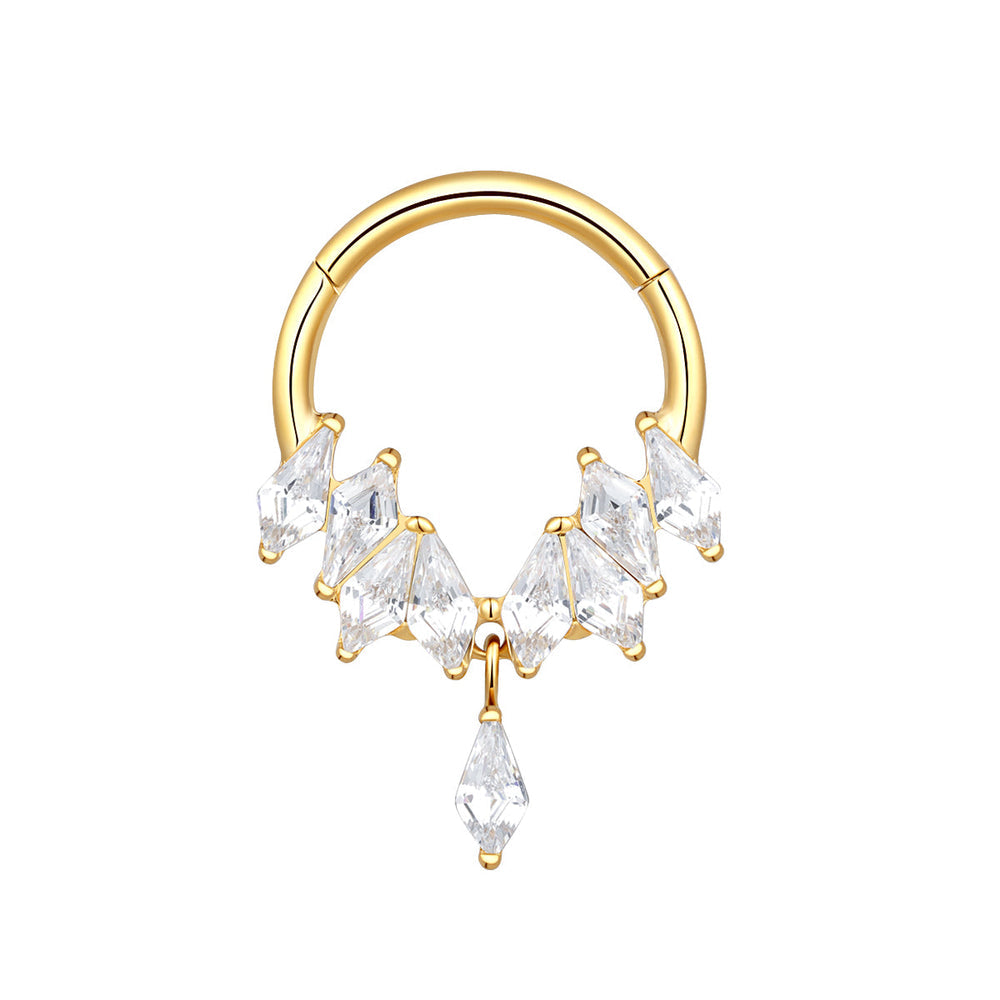
The six compatibility layers
Threadless, internally threaded, externally threaded, clicker, segment, captive, or another structure.
The nominal post or ring thickness must match the intended component and use.
Pin diameter and length, thread pattern and depth, hinge, seam, or tension mechanism.
Post length, inner diameter, curvature, and clearance.
End width, setting height, orientation, dangle clearance, and stone layout.
Component material, color, finish, and any restrictions on mixed-material assemblies.
Compatibility matrix
| Component pair | Possible relationship | Required check |
|---|---|---|
| Threadless end + threadless post | Potentially compatible. | Gauge, pin geometry, retention design, insertion depth, orientation, supplier-approved family. |
| Internally threaded end + internally threaded post | Potentially compatible. | Gauge, thread pattern, stem length, engagement, gap, supplier-approved family. |
| Threadless end + internally threaded post | Not the same connection system. | Do not combine unless a specifically designed adapter or system is documented. |
| Clicker segment + another ring body | Usually treated as a matched assembly. | Hinge, closure geometry, seam alignment, gauge, diameter, and manufacturer instructions. |
| Horseshoe end + circular barbell | Potentially compatible within a defined family. | Thread system, gauge, end clearance, and complete engagement. |
A practical incoming check
- Read the purchase specification and component-family identifier.
- Separate lots and do not mix unlabeled components.
- Measure the agreed critical dimensions using calibrated tools and the approved method.
- Check engagement, retention, alignment, gaps, movement, and finish without forcing the parts.
- Record nonconforming combinations and quarantine them from saleable stock.
- Update the internal compatibility matrix only after the business approves the evidence.
How compatibility should appear in a catalog
Each component page should show the compatible system, gauges, post or end family, critical dimensions, material, piece count, and a direct link to matched components. Use filters for discovery, but keep the technical specification on the product page.
“Fits our threadless posts” is clearer than “universal.” Link the statement to the exact post family and list the supported gauges or specifications.
Sources, scope, and review
This page explains general product and sourcing concepts. It does not certify a NYONDIAMOND product, prescribe jewelry for an individual, or replace a qualified piercer or medical professional.